
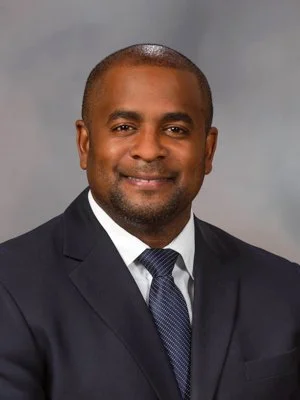
With more than 20 years of leadership experience in academic and healthcare settings, Dr. Driscoll DeVaul is passionate about student success, faculty development, interprofessional education and academic innovation. We spoke to him recently to get his thoughts on how best to prepare the next generation of healthcare professionals.
ASAHP: You’ve led many initiatives at UMMC. Tell me more about the annual IPE Campus Welcome Interprofessional Education Block Party? How long has that been going on and what does it entail
Driscoll Devaul ( DD): The IPE Campus Welcome Interprofessional Education Block Party is something we started five years ago. We thought this was a great opportunity, as students are coming back to school in the fall, to bring undergrad and grad students together from our six schools of health professions as well as our medical, dental, nursing, pharmacy schools and our school of population health. The goal is twofold. First, we want to raise awareness about events on campus as well as all of the different resources that are available such as financial aid, student success, etc. Second, we want to promote these students being together and working together because, ultimately, they will be colleagues together. We’re building relationships now so that it will be second nature later. We also include outside vendors at this event such as local gyms, peer tutoring and mental health counselors. We even have reps from the adult hospital attend, which spurs recruitment of our students in action. We’re promoting interprofessional education and collaboration from the start. Plus, it’s fun! We have competitions among the different schools - it’s a big block party.
ASAHP: How has that initiative benefitted students as well as faculty?
DD: The biggest benefit to everyone is relationship building. Students become more comfortable communicating with their peers from other professions. We want that familiarity to be something that reduces the barriers and encourages mutual respect amongst different programs. Faculty also benefit because it creates opportunities for collaborations across schools, and strengthens partnerships among different faculty members who may work together on simulation activities, research, and other projects in the future.
ASAHP: Are there any tips you’d give to colleagues who might want to plan a similar event?
DD: This event was the brainchild of the School of Health Related Professions - we wanted to create a one-stop shop. We are blessed to have an amazing Office of Well-Being. They’ve been great partners. I would suggest to other schools that they include resources from their school such as an Office of Well-Being from the outset. It creates a great opportunity to have strong support and it creates buy-in with everybody!
ASAHP: You’re a strong advocate for Interprofessional Collaboration. Can you share some real world examples of how you think IPC has benefitted health professions students as well as the overall field of health professions?
DD: Healthcare today is far too complex for any one profession to work independently. During COVID, I was a respiratory therapy director here at our institution. We all worked together - physicians, nurses, physical therapists, occupational therapists, respiratory therapists, speech, pharmacy, dietary, social workers, labs, etc. Each discipline contributed their unique expertise. We all remember that those were very trying times. When students learn together, they develop an appreciation for one another's knowledge and responsibilities. I've always preached for students to get outside of their silos and recognize that there's so much that can be done when everybody works together to provide the best care possible.
ASAHP: How do you believe investing in faculty development pays off for students and for your school?
DD: Our faculty are our greatest educational resource and having an opportunity for them to grow and develop is so important. When we invest in faculty development, we're directly investing in student success. Healthcare evolves so rapidly and our faculty must have a mechanism to continually grow alongside the advancements in technology, educational methods, accreditation, and clinical practice. We want our students to be well prepared because this generation has to be better than we could even imagine being. We want these students to have great instructors. We want to pour into our faculty and give them everything they need to be successful. We try to create great, engaging development sessions that help empower faculty to provide the best education and training possible.
ASAHP: You’ve worked for 20 years in clinical and healthcare leadership in the field of respiratory therapy? What drew you to that field and are there skills and strategies that you’ve acquired over those two decades that might benefit other health professions?
DD: One of my siblings had asthma, and we were always at the hospital so I got a good sense, as I was growing up, of what a respiratory therapist did. It appealed to me because it combines critical thinking, advanced technology and opportunity that makes an immediate impact in patients' lives. I always tell our students about the importance of respiratory therapy because if a patient’s not breathing, nothing else matters. Throughout my career, I’ve worked in critical care, emergency medicine, transport medicine, and healthcare leadership. Those experiences have taught me that technical expertise alone just isn't enough. Some of the most important lessons I've learned involve communicating effectively, emotional intelligence, leadership and adaptability. Healthcare is truly a team sport. Whether you're a respiratory therapist, physician, lab scientist, PT, OT or administrator, your success depends on the ability to communicate effectively, build trust and continually improve.
ASAHP: Tell me about some of your upcoming projects including the Error Prevention Training and the RISE Peer Support Program?
DD: These are two initiatives that I'm very excited about. Error Prevention Training is an opportunity to focus on developing high reliability behavior which can reduce preventable errors, improve communication, situational awareness, accountability and teamwork. We encourage our students if they see something that looks wrong, to say something.
I've been a part of RISE for several years. RISE stands for Resilience In Stressful Events. It’s a national program that we brought to UMMC. It comes from a situation when something difficult happens on the unit and team members may be in need of support. It's a peer support program that recognizes that healthcare professionals experience emotionally difficult situations throughout their careers - whether it's an unexpected patient outcome, traumatic clinical event, or simply just the stress of healthcare. We provide a structured way to deal with that situation to help colleagues recover and remain resilient. We have an evidence-based script that helps us provide the needed support. It’s not as much about being a counselor as it is about listening, and redirecting that colleague to appropriate resources to help them deal with the situation.
ASAHP: What are some of the realities of modern healthcare for which you think health professions students need to be better prepared?
DD: Healthcare is changing faster than ever. Students must be prepared for the rapid technology, technological advances, AI, data-driven decision making, telehealth, workforce shortages, etc. In the increasingly complex patient populations that we're taking care of now, there are many things for which students have to be prepared. Equally important is the human skill. Students need to be resilient, and adaptable with strong communication skills and cultural humility. They also must have exceptional emotional intelligence because everything is constantly changing. Technical skills will get someone hired, but collaboration, professionalism, leadership, and continuous learning is going to be what keeps them in the job. We need lifelong learners because healthcare today will be different in 10 years.
ASAHP: Anything else we should know about you or anything you’d like to add?
DD: I want to say that ASAHP has been amazing. I’ve been blessed to be on different committees and learn from great colleagues. I’m excited about ASAHP’s annual conference in October because that’s another way that we can arm ourselves with as much information as possible to make our schools better. I also want to share a philosophy that has guided my career and that’s the belief that leadership is about serving others. I started my career here as an equipment tech in the respiratory therapy department, and now I'm the assistant dean for academic affairs. My goal is to help others to succeed. I believe that education has the power to transform lives, and every student who graduates from our school or another school has the potential to positively impact thousands of lives of patients throughout their career. That's an incredible responsibility and an incredible privilege. I want to do all I can to improve the health of others, to improve future healthcare leaders and to improve the lives and health of Mississippians.
* If you’d like to learn more about Driscoll DeVaul’s work, feel free to email him at: ddevaul@umc.edu.