

In response to the Department of Education’s (ED) Notice of Proposed Rulemaking (NPRM) which would reduce student loan opportunities for allied health professions education as well as nursing and public health programs, the Association of Schools Advancing Health Professions (ASAHP) submitted comments to ED urging the Department to classify allied health programs as qualifying professional degree programs eligible for the higher student loan cap.
Department of Education Issues Interpretive Rule on Accreditation
Health Care Groups Form Coalition to Fight Loan Caps
Inside Higher Ed covered the work of a newly formed coalition, of which ASAHP is a member, which is spearheading advocacy in response to proposed Department of Education rulemaking on Higher Education Act provisions stemming from the One Big Beautiful Bill Act, including the new student loan caps which would exclude most allied health graduate and doctoral programs from higher student loan caps.
The article by Inside Higher Ed may be accessed here.
Save the Dates: May 2026 IPEC Institute

IPEC's next virtual Institute will take place May 5, 7, 12, and 14, 2026. Build skills to strengthen curriculum design, assessment, and implementation through interactive sessions and practical tools that support IPE and collaborative practice. Registration opens soon. Visit the IPEC website for updates.
Nominate for the IPEC COF Award

Are your students or faculty collaborating across disciplines to advance IPE? Nominate your institution for the Excellence in IPE Collaboration Award, hosted by IPEC and the PHS Commissioned Officers Foundation. Nominations are open through February 27. Click here to apply.
Join the February 25, 2026 IPEC Symposium
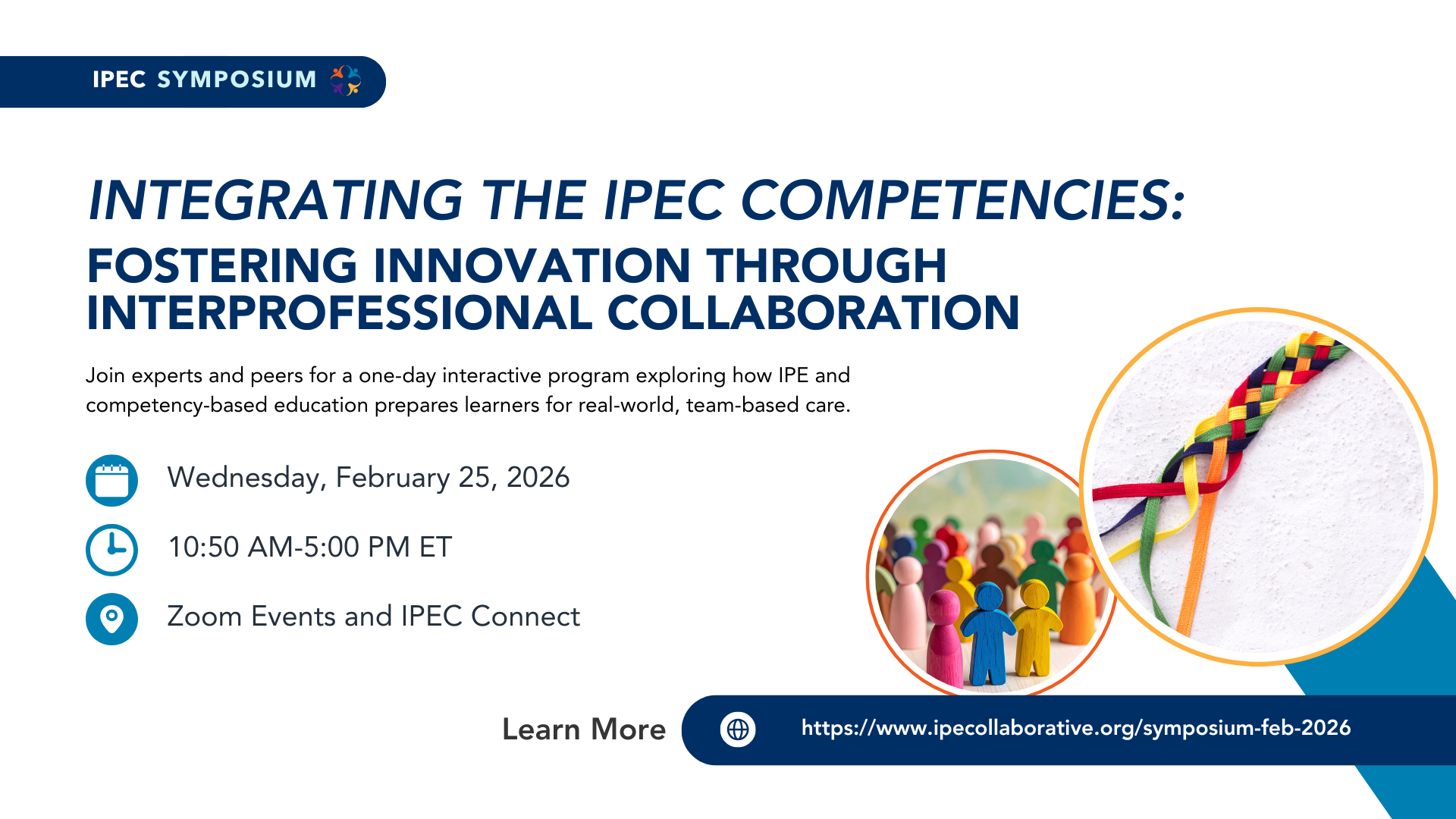
Engage with health professions educators and collaborative practice leaders at IPEC's upcoming virtual Symposium. Explore competency-based education, the IPEC Core Competencies, and practical strategies for advancing interprofessional education (IPE) on February 25. Click here to register today. Association members receive the IPEC member discount.
HRSA’s Area Health Resources Files (AHRF): County-Level Data for Workforce Planning
HRSA’s Workforce Projections Dashboard: Plan for Future Health Careers
HRSA’s Health Workforce Explorer: See Where Health Professionals Are Needed
Journal of Allied Health Seeks Editor-in-Chief
The Journal of Allied Health (JAH), the official scholarly publication of the Association of Schools Advancing Health Professions (ASAHP), seeks an Editor-in-Chief. The candidate will transition into this role to ensure the long-term continuity of the Journal, working closely with the current Editor-in-Chief, while he transitions to Editor-in-Chief Emeritus role.
A Continuation of Our Conversation with ASAHP’s new President Jon Williamson, PhD, FASAHP

House Education & Workforce Committee Hearing on "Runaway College Spending Meets the Working Families Tax Cuts"
The House Education and Workforce Committee held a Subcommittee on Higher Education and Workforce Development hearing titled “Runaway College Spending Meets the Working Families Tax Cuts,” to examine the rising costs of higher education and potential strategies to increase access for working families.
ACE to Host Capitol Hill Briefing on Professional Degree Students and Their Lack of Access to Federal Student Aid
On Tuesday, February 10, at 3pm Eastern, the American Council on Education (ACE), of which ASAHP is a member, will host a Capitol Hill briefing for congressional staff and interested parties titled, “Professional Degree Students and Their Lack of Access to Federal Student Aid”. Jessica Blake of Inside Higher Ed will moderate a panel featuring Rep. Mike Lawler (R-NY) and others.
More details are here. ACE put out a two-page document here with background and talking points on the issue.
House Passes and President Trump Signs FY 26 Labor-HHS Bill Package, Ending Partial Government Shutdown
This afternoon, the House, in a 217-214 vote, passed the five-bill spending package funding the FY 26 Labor-HHS, Defense, Transportation-HUD, Financial Services, and National Security-State bills through the remainder of the current fiscal year, along with a Continuing Resolution (CR) funding the Homeland Security bill through February 13. 21 Democrats joined most Republicans in support, while 21 Republicans joined most Democrats in opposition. Prior to final passage, the House voted 217-215 to adopt the rule to consider the legislation, with Rep. Thomas Massie (R-KY) joining all Democrats in opposition. The Senate passed the package on Friday, and President Trump signed this package this afternoon, ending the partial government shutdown which began at midnight on Friday.
A statement from the Health Professions and Nursing Education Coalition (HPNEC), of which ASAHP is a member, is here.
Senate Passes Funding Package Including the Labor-HHS Bill
On Friday evening, in a bipartisan 71-29 vote, and after Senators and the White House forged a compromise deal yesterday, the Senate passed a FY 26 funding package comprised of the Labor-HHS, Defense, Transportation-HUD, Financial Services, and National Security-State appropriations bills. Those bills would be funded through September, the remainder of the fiscal year.
The Senate also passed a Continuing Resolution (CR) for the Department of Homeland Security through February 13, allowing more time for Congress and the White House to negotiate that bill.
The five-bill funding package and Homeland Security CR now need to be passed in the House. Speaker Mike Johnson (R-LA) has said he hopes to bring up the bills under suspension of the rules, a fast-track process which requires a two-thirds vote in the House. A vote is expected as early as Monday. The likelihood of quick House passage remains uncertain.
The current CR for the six FY 26 bills, including the Labor-HHS bill, expired at midnight on Friday, triggering a partial government shutdown lasting until the House passes the funding package and President Trump signs the bills.
Department of Education Issues Notice of Proposed Rulemaking, Public Comment Period on Higher Education Loan Caps
Yesterday the Department of Education issued a Notice of Proposed Rulemaking (NPRM) addressing changes to the Higher Education Act (HEA) included in the One Big Beautiful Bill Act, following the Reimagining and Improving Student Education (RISE) negotiated rulemaking committee reaching consensus on the package of proposed regulations in November.
The proposed regulation sets new student loan caps for graduate students, with a higher cap for those pursuing a professional degree. Graduate students would be limited to $20,500 in student loans per year (an up to $100,000 aggregate cap), while professional students would be limited to $50,000 in federal student loans per year (an up to $200,000 lifetime cap). The regulation narrows the programs that qualify as professional degrees, meaning students pursuing an array of advanced degrees in high-demand professions—such as allied health, nursing, and public health—would not be able to borrow as much as those in unaffected fields. The regulations would also eliminate the Grad PLUS program and multiple loan repayment options, limit Parent PLUS, and introduces streamlined repayment options for borrowers.
Since this issue arose, ASAHP has joined other organizations in outreach to the Department of Education (here, here, and here), urging that health professions programs qualify for the professional degree caps and expressing concern that a new, narrow definition of what constitutes a professional degree will deepen the health workforce shortage by creating uncertainty and limiting access to vital support for students entering critical health fields.
Public comment on the proposed regulations is now open through March 2. The Department of Education press release is here. The NPRM is here. Coverage from Inside Higher Ed is here.
A Conversation with ASAHP’s new President Jon Williamson, PhD, FASAHP
House Passes FY 26 House Labor-HHS Bill, Senate Consideration Next Week
Yesterday, the House passed a spending package, closing out its work on FY 26 appropriations. After passing the Homeland Security bill, the House passed a three-bill “minibus” package including the Labor-HHS, Defense, and Transportation-HUD bills in a bipartisan 341-88 vote. The Senate is expected to take up its remaining bills, including the House pass Labor-HHS bill, in a six-bill minibus package to expedite their passage in advance of the January 30 funding deadline. Once passed by the Senate, these appropriations are expected to be signed by the President.
The Health Professions and Nursing Education Coalition (HPNEC) has produced a chart on Health Resources and Services Administration (HRSA) Title VII and VIII Health Workforce Programs funding, which may be accessed here.
ASAHP Announces 2025 Scholarship of Excellence and Elwood Scholar Award Recipients
IPEC Symposium Early Bird Registration
IPEC is excited to invite you to the 2nd IPEC Symposium on February 25, 2026: “Integrating the IPEC Competencies: Fostering Innovation Through Interprofessional Collaboration.” The first IPEC Symposium was a tremendous success, attracting over 100 participants from across the country and globe. Building on that momentum, the upcoming symposium will focus on IPE, competency-based education (CBE), and the IPEC Core Competencies, offering even more opportunities to connect, collaborate, and learn from experts